Sunday, April 15, 2018

The Author Explains His Poem, To Touch The Pain, A Poem Of The Healer

My Poem, To Touch the Pain, A Poem of the Healer, is found on page 11 of my book Beyond These Dark Lands Are Edges of Joy, Words of Comfort and Hope.

I wrote this poem for those who seek freedom from the burdens of their inner pain and to point them to The Lord who is the master physician of hurting hearts.

TITLE

I gave it the title, To Touch the Pain, with some reservation because A person may not want to be reminded of their pain. The subtitle takes us from pain to the Healer.

STRUCTURE

This poem is 21 lines long and most are three and four syllables, except for lines 12 through 16, where a new rhythm makes the main point of the poem stand out

The poem does not have much in the way of illustration but opens with a metaphor for pain.

"You have known pain
For so long
It has now fused
To your soul

Like hardened iron."

I did not want to belittle the pain anyone feels, but to acknowledge it.

The 21st line makes a concluding point and that line is given effect by being six syllables long.

    TO TOUCH THE PAIN,
    A Poem of the Healer

    You have known pain
    For so long
    It has now fused 
    To your soul 
    Like hardened iron.
    Its weight breaks you,
Illustration for the poem, To Touch The Pain,
A Poem of The Healer
© 2018 By A.E. Dozat
    And you need
    To be made whole.
    This pain is deep,
    Unending and dire.
    You are willing
    To try any cure,
    Make any sacrifice,
    And pay any price; 
    Why not
    Consider God?
    If you reach for Him
    You will find 
    He is willing,
    And you will learn
    That to touch Him
    Will begin
    Your healing.


MEANING
This poem is simple. It describes the struggle with pain, then asks that since you are willing to do anything for relief "Why not consider God?"  It encourages you to reach out to God because you will find that He is willing to begin your healing.

ILLUSTRATION

The illustration is a pen drawing of a road that leads across on a rocky desert landscape. In the middle ground is a cross.

This poem, like many in the book, will inspire people to be open to God's healing and working in their lives. I hope that when a person is ready to deal with their pain that they consider the comfort and healing from a source that was rejected before, and look to God.

The footnote is a Bible verse, Come to me, all you who are weary and burdened, and I will give you rest. Take My yoke upon you and learn from Me; for I am gentle and humble in heart, and you will find rest for your souls. For my yoke is easy and my burden is light. Matthew 11:28-29, NIV
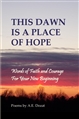
You can read this poem on page 11 of the book. 

To read a review CLICK HERE.

© A.E. Dozat 4/8/18

Book cover image

This Dawn Is A P ...

Adron Dozat

$6.99

Buy Now button

Sunday, April 8, 2018

The Author Explains The Meaning of His Poem, Its Power Never Ends

The Poem, It's Power Never Ends, A Poem about the Source, is on page 10 of my Book of Poems, Beyond These Dark Lands Are Edges of Joy, Words of Comfort and Hope.

This is a poem of rational hope, a hope that is founded on an intelligent belief in God's active mercy in our lives.  It is my vision that this poem will inspire others to a deeper hope in God during their difficult times..

TITLE
I wanted the title to grab the reader's attention immediately. It makes you wonder what the "It" is, and what the "Power" is.

The subtitle, A Poem about the Source, is to deepen the reader's curiosity. You assume that this fundamental something that is powerful eternally.

Illustration for the poem
Its Power Never Ends, A Poem of The Source
From the Book
Beyond These Dark Lands Are Edges of Joy
© 2018 By A.E. Dozat
STRUCTURE
This poem is 29 lines long and forms eight sentences. The overall tone is direct like a 98-word sermon. I did not use metaphor and imagery. The lines are short, some have only one or two words. Most lines are four five or six syllables with very few rhythms. There are two halves; the first half makes a statement and the second half expands the statement.

WHAT IT SAYS
This poem makes its point early in line five that the poem is about hope.
The next three phrases began to expound on hope...
"Hope is as strong or
As weak as
Who your hope is in."
It points out that we should not blindly hope in hope, but we must hope in God who is not only able to meet all of our needs for deliverance He is divinely worthy of our faith.
Lines 12 through 14 points out that we must clearly define who or what our hope is in. The poem ends like a Psalm where God is declared worthy of our hope.

ILLUSTRATION
Most of the book's illustrations have a road going through the dark lands. In this illustration, the road winds around a hill with an empty tomb representing lines 20-21.

SCRIPTURE
The footnote is the verse from 1 Corinthians, "Three things will last forever--faith, hope, and love--and the greatest of these is love". 1 Corinthians 13:13, NLT

This poem is a valuable statement that we can have hope. Reading it will strengthen those who need reassurance that God is worthy of their hope.

You can read this poem on page 10 of the book. 

© Adron 4/8/18


Thursday, April 5, 2018

The Author Explains the Meaning of the Poem, His Place.

His Place, A Poem of Renewal, is found on page 9 of my book, Beyond These Dark Lands Are Edges of Joy, Words of Comfort and Hope.

I wrote this poem to inspire people that in the trauma of difficulties we can find peace in God but we must seek Him.

To get it through Amazon CLICK HERE.

TITLE
This is one of the more simple and obvious titles. The phrase, His Place, directs us to look to The Lord. Of course, Place is not a physical location but a spiritual one.

The subtitle, A Poem of Renewal, is very important because that when we spend time with The Lord we are renewed and able to live in the world victoriously.

Illustration for the Poem His Place
from the Book, Beyond These Dark Lands,
are Edges of Joy, Words of Comfort and Hope.
© 2018 By A.E. Dozat
STRUCTURE
The poem is 21 lines long and forms eight sentences; almost every line is five syllables long. The tone of admonition goes throughout the poem. It begins with an imperative in line one, you must find that place..., in line eight, you must be faithful...,  in line nine, go there...,  and in line 14 neglect not...

The fourth line describes the place, it is a silent place... and God waits...

The poem turns from describing this spiritual place to the blessing we find there, the blessing of Him... that is from being in God's presence.

The last five lines are hopeful with and emphatic. In line 19 the words you will... is not a command but a result of being in the presence of the Lord. The poem ends with a positive declaration; you will carry His light...

WHAT IT MEANS
We must be devoted to finding God, even in difficult times. If by faith we meet with Him we will carry His peace through our day.

ILLUSTRATION
The picture I drew for this is a path leading up the side of a hill where a bench sits on an outcrop of rock that overlooks the landscape below. It is an attempt to illustrate a quiet place where we might meet with the Lord.

SCRIPTURE
The footnote for the page is the scripture reference of Exodus 34:35, “The people of Israel would see the face of Moses, that the skin of Moses’ face was shining.” It is about the time when Moses met with God on the mountain and his face was full of the brightness of having been in communion with God.

You can read this poem on page 9 of the book. If you would like to read a sample poem choose the link below for the website.

Beyond These Dark Lands 
Are Edges of Joy,
Words of Comfort and Hope
Poems by A.E. Dozat © 2018
If you are in need of encouragement or know someone who does you should order a copy today, you will glad you did.

To purchase through Amazon CLICK HERE. 

Use the Buy Now button for Paypal

$9.62 Plus $4.17 Basic Shipping


For large orders or digital downloads follow this link to TheBookPatch, my print on demand partner.
To find out more and read a sample poem visit my website, A.E. Dozat.com.

To read a review CLICK HERE.

© Adron 3/19/18

Wednesday, April 4, 2018

The Author Explains the Meaning of His Poem, Extreme Knowledge

The poem, Extreme Knowledge, a Poem about His Choice,

This poem is found on page 8 of my book Beyond These Dark Lands Are Edges of Joy, Words of Comfort and Hope. Published 2018.

I wrote this poem to remind hurting people that they are not alone with pain. The Lord personally knows your pain; because the Lord carried your sin to Calvary then He carried your pain too.

To order your copy directly from the printed at the best wholesale pricing  CLICK HERE.

TITLE

Illustration for the poem, Extreme Knowledge
From the Book,
Beyond These Dark Lands Are Edges Of Joy
© 2018 By A.E. Dozat
This title was easy for me. The word, "Extreme" has several connotations; one is the utmost physical exertion, which points to the suffering of Christ described in the poem's conclusion.

The words, "His choice," points to God.  He chose to create us and give us life. He chose to redeem us after we fell from grace. He chose to become mankind's redemption by His sacrifice on the cross for us.

The reference to knowledge goes both ways, God knows us and wants us to know Him through the bridge of Christ's sufferings which Christ endured on our behalf.

STRUCTURE

This poem is 26 lines long.  Like most of my poems, the lines are short. It is like a free-verse poem, but with random repeating rhythms to give it some structure. Most of the repeats are couplets.

WHAT IT SAYS
The poem begins by acknowledging our pain, and then asks, "Does anyone know... my pain?" The answer is a description of the pain Christ endured for mankind's sin. It concludes with an affirmation of his knowledge of our pain.


EXTREME KNOWLEDGE,
A Poem About His Choice

We know that
Pain is worse
When carried alone.
And we ask,
"Does anyone know
My hurt,
My loss, 
Suffering, 
And my pain?"
Yes, there is one who knows.
The Pain Bearer knows
Your hurt,
Your loss,
Anguish,
And more-
He knows
Its price.
Your pain
Is real to Him;
As real as the 
Lashings across His back,
The piercing of his hands,
And the laceration
Of the twisted thorn crown.
He knows your pain
Firsthand.


MEANING
There is a doctrine that Christ identified with mankind when he took our sins upon himself and paid their penalty. I push this a little with the suggestion that in suffering for our sin he knows our pain too.

FOOTNOTE
The Scripture reference is from Isaiah 53:6, which says, "the Lord has laid on Him the iniquity of us all."

ILLUSTRATION
The illustration for this poem is of a cross beside a path on a mountainside.

To order your own copy of this book of comfort and hope directly from my printer at the best wholesale pricing CLICK HERE.

© Adron 4/4/18

Thursday, March 29, 2018

The Author Explains The Meaning Of His Poem, Fruit of Repentance

My Poem, Fruit of Repentance, A Poem of the Spirit, is found on page 7 of my book Beyond These Dark Lands Are Edges of Joy, Words of Comfort and Hope. It is a poem that will bring you closer to God and give you the strength to move forward through a difficult time.

TITLE
Repentance is understood as meaning to turn around or to reverse the direction of your actions. To think of repentance as being something that produces fruit is a new concept for many people. The reference to fruit has a double meaning which those who are familiar with the fruit of the Spirit found in the Bible will understand. See the Scripture reference in the footnote on page 16.

STRUCTURE
This poem is 28 lines long but many lines are one word, and most are three or four syllables long though a few are five or six syllables long. This poem is without metaphor or imagery, but it is a dialogue written as a prayer. The form of this poem is like a prayer since it opens with the address to God. "Father, of love..."

The next two lines form a couplet of three syllables each followed by a line of four syllables. This structure is repeated three times as the prayer-poem rushes into a confession. The sins confessed are lovelessness, joylessness, and peacelessness.

Line 11 introduces the fourth sin, it is a summary of the first three and infers many more.
"Forgive me
For the sin
Of stifling
Your spirit 
From presenting
Its fruit in me."
The point is made at the end of most of my poems, but the point comes early in this one then follows it with a sub-point.

The last seven lines do not have rhythm but the lines are a familiar length. The lack of rhythm draws the reader's attention to each statement. The prayer-poem changes to petition and askes God to lead you to repentance. The concluding lines are an affirmation of faith.
"I now receive
By faith
The gifts of 
Love, joy, and peace."

WHAT IT SAYS
In my poems, I avoid anything like advice since I am not a counselor or therapist, but on matters of faith I can speak confidently so this poem contains aspects of teaching for those of faith.
Illustration for the Poem, Fruit of Repentance,
From the Book
Beyond These Dark Lands are Edges of Joy
By A.E. Dozat©2018

People accept that a lack of love is a matter that requires repentance but to say the same of joy and peace is new for some. All three are equally a fruit of the spirit, all are commands, and all are gifts from God; if they are not present in your life than something is wrong. The first step in the Christian culture from which I write from is to confess and repent

WHAT IT MEANS
If you do not possess love, joy, and peace then you that must confess and repent of it. We have a responsibility to have love, joy, and peace even though they are the fruit of the spirit. The spirit will bring the fruit if we let it and so we have to begin with confessing it as a sin and repenting of that sin and receiving the power of God's Holy Spirit to bring the fruit in our lives.

ILLUSTRATION
The illustration for this picture is symbolic it is a dove. This illustration breaks away from the others because it is one of the few without a road leading through the land.

You can read this poem on page 7 of the book.
© Adron 3/29/18

Saturday, March 24, 2018

The Author Explains His Poem, Identity, A Poem of The Freedom Place

The Poem, Identity, a Poem of The Freedom Place, is found on page 6 of my book of poems, Beyond These Dark Lands Are Edges Of Joy, Words of Comfort And Hope.  This is a poem that gives hope in God during your darkest days.


TITLE
I always struggle to come up with titles for my poems and often wait until after the piece is written. I want one that is not obvious but is a clue to the poem so readers will be forced to think about it.

With this one, I went through several titles as the poem took form. I ended up with a title that refers to a doctrine of the Christian faith about our accreditation before God as being hidden in the sacrifice of Christ. The scripture at the bottom of the page, Romans 8:1, is a reference to this teaching.

STRUCTURE
The 27 lines make this one of the longer poems in the book. There are three sentences which are broken up by line breaks, most of which are 5 and 6 syllables long with a few exceptions placed for emphasis.

Illustration for the poem,
Identity, a Poem of the Freedom Place
From the Book,
Beyond These Dark Lands Are Edges Of Joy
© Adron 2018
It starts with a repeating phrase of three syllables followed by a five syllable line,
"You try, and
 You try, and
 You try to do good..."
(Yes, I know it is redundant and a cheap emphasis). The drama is further set up by two lines of five syllables,
"But your failure
Seems to be stronger..."
The poem takes the first turn with two 5 syllable lines,
"Until your bones ache
With guilt and remorse."
The next turn introduces the hope,
"But the promise of God
Is..."
This is part of a set of six lines of five and six syllable lengths, which cause the reader to move through with ease. This section leads the audience to the hope which is the object of the poem.
Line 24 ends the second sentence with the two words, "In Christ."

The poem switches to a soft voice as it concludes. The conclusion is made of three lines of different lengths, so the reader pauses to consider each meaning. The bluntness of the conclusion is a contrast to the metaphors earlier. The soft voice calms the bluntness of the last statement.

WHAT IT SAYS
This poem says that in spite of our best efforts we experience failure of character or purpose, leading to guilt and shame. But there is hope because those who have come to God through faith in Christ will find that they are free from guilt and condemnation.

WHAT IT MEANS
This poem points to eternal, powerful, and abiding hope. It is not a hope in our efforts or some vague force of the universe. Our hope is in God because He does not condemn our failures if we are in Christ.

This makes sense of the second part of the title because our freedom from judgment is through our identifying with Christ.

This poem points out that if a person is feeling guilty and discouraged by failure in their lives they can have hope because of Christ in their lives.

ILLUSTRATION
The picture I drew for this is a road through a barren land divided by a crevasse. It illustrates the first half of the poem about our defeat.

You can read this poem on page 6 of the book. If you would like to read a sample poem choose the link below for the website.

© Adron 3/24/18

Wednesday, March 21, 2018

An Author's Discussion Of His Poem, He Who Works

This poem, He Who Works, A Poem about Your Plan, is on page 5 of my book, Beyond These Dark Lands Are Edges of Joy, Words of Comfort and Hope.

I wrote this as a poem of reassurance of the loving purposes of God on your behalf.

TITLE
The title, He Who Works, A Poem About Your Plan, is in contrast to the poem. A reader may think it is about their own plans by the words, "about your plan." However, when you read it you find it is not about the plans you have made, but they involve another one.

MY CREATIVE PROCESS
I often start with an image or word picture of something and weave my message into it. This one began with the desire to say something particular. First, I wrote it out as a simple statement, then tried for days to come up with imagery to explain my thought but nothing fit. I tried different rhythms but felt the message was diluted by too much structure.  I returned to the original thought and kept rewriting each section until it said what I wanted.

STRUCTURE
A drawing of a wheelbarrow with flowers ©
Illustration of the poem, He who works
from Beyond These Dark Lands Are Edges Of Joy ©
This poem is so simple it is barely a poem at all. It is in a free-verse style and has only 20 lines forming five sentences. Some of the line breaks are one or two words long. It starts out conversationally with two "they say," and "you ask" statements; this brings us to a question that sets up the poem's concluding narrative.

WHAT IT SAYS
It starts with, "They will tell you God is good..." This is what people of faith say to encourage others in their times of difficulty. But lines follow that ask, "You say, 'where is the good...'" The poem acknowledges the pain "Yes, it hurts..." Then offers an explanation, "but God is working." The last five lines are an affirmation of God's love and goodness.

WHAT IT MEANS
We have a different perspective of God's goodness when we experience trials than when we are at ease. When we question God's purpose we may not get an explanation that satisfies us, but there are reasons to trust God and to hope during these times.

ILLUSTRATION
The poems in this book are illustrated.  A theme in many drawings is of a road leading through a landscape, some of the scenes are pleasant and others are barren. I choose a pleasant scene for this one, with a cart full of flowers beside the road.

You can read this poem on page 5 of the book. 

© Adron 3/21/18